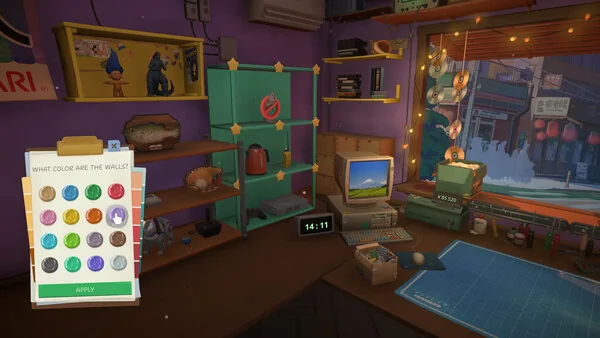
Searching for a ReStory competition guide usually means you want a clean plan before a timed or scored challenge: which job details to read, what to inspect first, and how to avoid losing a good run to an unnecessary purchase. The public Steam description confirms the parts of the game that matter for that plan: you take in nostalgic electronics, open them, clean them, replace faulty parts, reassemble them, manage orders and make choices that can affect customers. It does not name a complete competition ruleset. This guide therefore treats competition as a challenge context and keeps every unverified score, timer or named round clearly marked.
Prepare as if each attempt is a repair record: read the customer hand-in twice, classify the device, inspect before shopping, separate cleaning from replacement, test before hand-back, and write down the dialogue choice. That order is useful whether the challenge rewards speed, accuracy, money, or a later story flag.
02
What this competition guide can confirm
The strongest public evidence is the official Steam listing. It describes a single-player shop-management simulator built around accepting jobs, opening nostalgic devices, cleaning them, replacing broken parts and putting them back together. It also mentions a spare-parts browser, in-person and online orders, customer stories, choices that can affect lives, and a replayable branching story with multiple endings. Those details are enough to define a sound preparation loop, but they are not a published competition spreadsheet.
That distinction matters for searchers. A phrase such as "competition times" may describe a particular current-build challenge, a community nickname, or a result screen that has not been documented publicly. This page does not turn a Similarweb query into a fact. Use the method below to reproduce an attempt, then add the exact round, device, timer, score and build date if you can verify them in game.
- Confirmed: ReStory is a single-player electronics repair shop game with cleaning, part replacement and reassembly.
- Confirmed: customers have stories and choices can connect to a branching storyline with multiple endings.
- Working note: a competition attempt should be logged like a job, even when the scoring rule is not yet known.
- Open: exact rounds, target times, score thresholds and named competition rewards need current-build evidence.
Keep the evidence boundary visible: ending notes · customer stories
03
Prepare the shop before the challenge
A competition run becomes fragile when preparation is mixed with improvisation. Start with a small written record, even if you only use the browser checklist on this page. Note the customer request, the device family, the symptom, the available cash and any deadline or wording that sounds like a condition. The record gives you a baseline when a second failure appears and stops a plausible guess from becoming an expensive order.
The goal is not to buy every likely component. The goal is to keep enough flexibility to respond after inspection. Steam confirms that the game includes a parts browser and several order types; it does not publish a universal shopping list. Treat the parts database as a lookup after the device has been opened, and keep the first pass focused on diagnosis.
Read the hand-in twice
On the first pass, capture the customer's story and urgency. On the second, underline the physical clue: device family, symptom, previous damage or a named accessory.
Classify the device
Use the family that best matches the item, such as console, handheld, phone, camera, music player or home appliance. A family is a starting hypothesis, not a hidden answer.
Protect a cash buffer
Leave room for a confirmed replacement and a second attempt. Spending on several plausible parts before inspection makes a speed challenge harder to recover.
Stage a clean bench
Separate visible dirt and oxidation from a suspected module failure. A clean surface may change the result, and you need to know which action actually helped.
Start a route log
Record the build date, customer clue, device, action order and dialogue choice. This is essential when a competition attempt overlaps with the branching story.
Useful lookups: device families · part roles · playtime log
04
Run every assembly attempt as a checklist
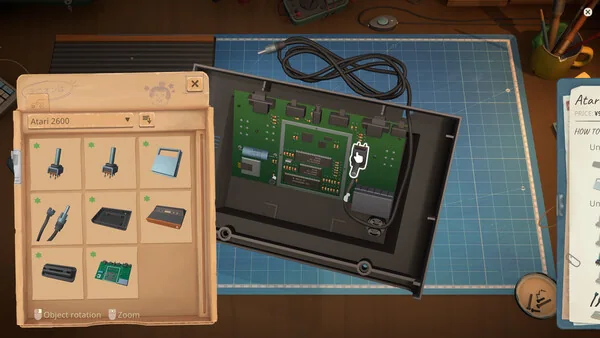
Once the item is open, use the same order on every attempt. Consistency is more valuable than a lucky fast click because it tells you why a result changed. Inspect first, clean only the surfaces the game exposes, choose a replacement only when the evidence supports it, and confirm the final state before handing the device back. If the challenge is timed, this routine also makes practice measurable: you can see which pass is slow instead of blaming the whole run.
Do not read the checklist as a claim that every device has the same hidden solution. The exact inventory, tool names and challenge thresholds are still marked for in-game verification. The checklist is an information architecture for a repeatable run, built from the repair loop that Steam publicly describes.
Inspect before shopping
Open the device and identify the failed area before visiting the spare-parts browser. Keep the symptom, the visible condition and your hypothesis in separate notes.
Test the safe distinction
Separate a dirty contact, a loose control, a power clue, an audio clue and a board-level suspicion. Do not promote a symptom to a component name without a check.
Clean as its own pass
Complete the cleaning action the current build exposes, then observe the state again. This lets you tell a successful clean from a replacement that happened to follow it.
Replace the supported failure
Order one evidence-backed part family at a time. If the result changes, record the exact part and the prior state before trying a second change.
Reassemble deliberately
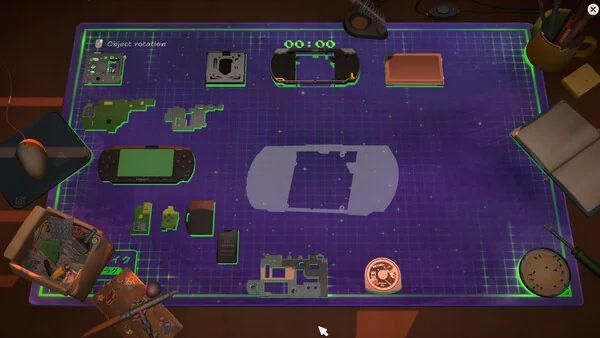
Confirm the visible connections, fasteners and selected part before closing the item. A correct diagnosis can still be lost during the final assembly pass.
Test and hand back
Use the result screen or customer hand-off as a checkpoint. Write down the result, money change, time signal and any new dialogue before leaving the job.
Pair this workflow with: the full repair loop · cleanliness troubleshooting
05
Protect the story route while you chase a result
A competition-style attempt may sit inside an ordinary customer job. Steam explicitly describes customers with unique stories, choices that can affect their lives and multiple endings. That means a fast repair is not automatically a good route. Before selecting dialogue, record what the customer asked for, whether the repair is complete and which clue led you there. If a choice feels like a moral or narrative fork, pause the timer mindset and preserve the context.
The site does not publish named competition endings or tell you that a particular response is safe. Use the public premise as a boundary: choices matter, but the exact branch condition needs a current-build reproduction. A screenshot or repeatable note from the game is more useful than a confident sentence copied from an unverified post.
- Save or record the job state before a high-stakes dialogue choice when the current build allows it.
- Write the exact response order, not a paraphrase such as "be nice" or "tell the truth".
- Separate an immediate customer reaction from a later ending flag; they may not be the same event.
- If a result is not reproducible, label it as a working note and leave the route open for verification.
For route context, open: customer choice notes · ending tracker
06
Log the variables that make a challenge useful
The phrase "competition guide" is only useful if another player can compare the same conditions. At minimum, write down the platform, game version or review date, customer clue, device family, starting cash, action order, parts purchased, completion time and result. If the screen exposes a score or rating, capture it before moving to the next job. A short structured log can reveal whether the challenge rewards speed, cleanliness, accuracy, profit or a story state.
When two attempts disagree, change one variable at a time. Do not rewrite the whole route after one failed run. Repeat the same device and opening clue, then alter the suspected step. This is slower than guessing, but it keeps the guide honest and gives future readers something they can reproduce.
Freeze the context
Record the date, platform, build marker if visible and the exact wording of the hand-in.
Mark the first divergence
Compare the successful and failed logs and identify the first different action, purchase or dialogue response.
Repeat the smallest test
Run the same opening again with one controlled change. Keep the result and the failure state, not only the winning attempt.
Share a reproducible note
Send the version, save or route context, exact choices and observable result through the contact page when you want the wiki to review it.
A useful follow-up is: send a correction · read research updates
07
Use this page without overclaiming
This page is deliberately practical and cautious. It gives you an order for preparing a competition attempt, while the official source remains the authority for the game's public premise. It does not claim a complete list of rounds, a fixed timer, a secret ending or a guaranteed score threshold. Those details belong here only after someone can reproduce them on a stated build.
If your search was really for a general first-job walkthrough, use the repair guide. If you need a named ending, customer branch, device family, part role or game-length estimate, use the focused pages below. Keeping those intents separate makes the competition guide easier to update when the community confirms a new result.
- Use the competition page for preparation, controlled attempts and evidence logging.
- Use focused pages for facts that already have a dedicated route and data model.
- Treat every unverified score, timer and reward as open until a current-build test supports it.
Choose the narrowest matching page: repair guide · achievement guide · platform notes
08
Competition attempt checklist
Use these fields for every run. The evidence column keeps a player observation separate from a fact confirmed by the official listing.
| Moment | Record | Evidence label |
|---|---|---|
| Before opening | Customer clue, device family, cash and any stated urgency | Player log |
| After inspection | Visible fault, safe tests and the part hypothesis | In-game observation |
| After cleaning | What changed before a component was ordered | In-game observation |
| Before hand-back | Part, assembly state, time or score signal | Current-build check |
| After dialogue | Exact choice, immediate response and route context | Working note until repeated |
09
The reliable competition habit
Treat each ReStory competition attempt as a small experiment: preserve the customer clue, inspect before shopping, keep cleaning and replacement separate, reassemble deliberately and log the result before moving on. Steam supports the repair shop and branching-story premise; exact competition times and rewards still need repeatable current-build evidence.
10
Competition guide FAQ
Does ReStory have a confirmed competition mode?
The checked Steam description confirms the repair shop, orders, customer choices and multiple endings, but it does not publish a named competition mode or rules table. Treat competition as a challenge context until a current-build result can be reproduced.
What is the best ReStory competition order?
Read the hand-in twice, classify the device, inspect before shopping, clean, replace only the supported failure, reassemble, test and record the hand-off. The order stays useful even when the scoring rule is not public.
Should I buy parts before opening the device?
Usually no. The game publicly describes a spare-parts browser and a repair loop; buying several plausible parts before inspection creates cost and evidence problems. Use the parts database after you have a supported hypothesis.
Can a competition choice change a ReStory ending?
Steam confirms a branching story with choices that can affect customers and multiple endings. It does not publish a complete competition route, so log the exact dialogue and mark an outcome as unverified until you can repeat it.
Where do I record a ReStory competition time or score?
Record the platform, build or review date, customer clue, device, action order, purchases, completion time, score or rating and result. Send a reproducible note through the contact page so it can be reviewed before being added as a fact.
Is this a ReStory walkthrough?
It is a focused preparation and evidence guide. For the general repair loop, use the repair guide; for endings, achievements, customers, devices or parts, use the dedicated pages linked above.